Cosmetic Packaging
Display Packaging
CBD Packaging
Retail Packaging
Product Packaging
Cigarette Packaging
Candle Packaging
Soap Packaging
Chocolate Packaging
Vape Packaging
Food Packaging
Gift Packaging
Bakery Packaging Boxes
Pizza Packaging
Bottle Packaging
Garments Packaging
Custom Printed Bags
Christmas Packaging
Toy Packaging
Cereal Packaging
Jewelry Packaging
Apparel Packaging
Shipping Packaging
Custom Pre Roll Boxes
Dispenser packaging
Eco Friendly Packaging
Custom Health Packaging
Pharmaceutical PackagingAn Inverter Voltage Stabilizer should protect sensitive equipment, not become another source of interruption. Yet repeated tripping often signals unstable input power, excessive load, overheating, or an internal protection response. A stabilizer may trip when voltage falls below its operating window, rises above its limit, or changes too quickly for the inverter circuit to regulate safely.
The Electric Power Research Institute has reported that power-quality problems cost commercial and industrial users billions of dollars annually. Its findings connect voltage disturbances, harmonics, and interruptions with equipment malfunction and productivity losses. IEEE 1159 also classifies sags, swells, interruptions, transients, and waveform distortion as important power-quality events. These conditions can appear harmless on a display, while producing sharp stress inside the inverter.
Roger C. Dugan, a recognized power-quality specialist and coauthor of Electrical Power Systems Quality, defines the issue clearly: “Any power problem manifested in voltage, current, or frequency deviations that results in failure or misoperation of customer equipment.” His statement fits this problem closely. A trip is not always a fault in the stabilizer. Sometimes it is the stabilizer correctly rejecting unsafe power.
Still, a neat diagnosis can be wrong. A warm enclosure, a clicking relay, or a burning-plastic smell may reveal more than a voltage reading. Loose terminals, blocked ventilation, motor-starting current, and undersized cables deserve careful inspection. The inverter may also trip because its batteries are weak or its cooling fan has failed.
For this reason, this article examines the real causes behind an Inverter Voltage Stabilizer trip, using field symptoms, electrical measurements, manufacturer guidance, and recognized power-quality practices.
An inverter voltage stabilizer protects sensitive equipment by controlling unstable electrical supply. It measures incoming voltage many times each second. A control circuit then adjusts the power before it reaches connected devices. In many designs, incoming AC is changed into DC first. The inverter creates a cleaner AC output from that DC source.
This process helps reduce damage from surges, voltage drops, and uneven power. It also supports equipment that needs steady voltage, such as control panels, computers, and medical monitoring systems. The stabilizer may disconnect its output when it detects overload, overheating, a short circuit, or input voltage outside its safe range. Some units switch to bypass mode instead. That behavior depends on the design.
A trip is not always a product failure. Dust around cooling vents can trap heat. A loose terminal can create resistance and raise temperature. A motor starting nearby can also cause a brief current spike. Measure, do not guess. Check the load rating, ambient temperature, input voltage, and error indicators. The displayed voltage may look normal after the trip, but the original event may have disappeared.
Protection settings are sometimes too sensitive, yet reducing them without technical guidance can create greater risk. Installation quality matters more than many users expect. An electrician should inspect repeated trips, unusual noise, burning smells, or damaged cables. Reliability comes from correct sizing, clear airflow, and regular testing.
An inverter voltage stabilizer trips when its control system detects a condition outside safe operating limits. Sensors continuously measure input voltage, output voltage, load current, temperature, and sometimes frequency. A microcontroller compares these readings with programmed thresholds. If voltage rises sharply or falls too low, the controller identifies a fault. It may also detect overloads, short circuits, excessive heat, or unstable incoming power.
The response is usually fast and deliberate. The stabilizer disconnects the load through an electronic switch or relay. Some models stop the inverter stage before opening the output circuit. This prevents damaged components from receiving abnormal current. A warning light, display code, or alarm may indicate the suspected cause. The controller then waits for a stable reading before reconnecting power. Short delays help prevent repeated switching during a storm or weak grid condition.
In field checks, I have found that a trip does not always mean the stabilizer is defective. A dusty cooling path, loose terminal, or heavily loaded motor can trigger protection. Measure the input and output with a reliable meter, then inspect the load separately. Do not reset the unit repeatedly. That can hide a developing fault. Detection systems are not perfect, either. A brief surge may be missed, while a temperature sensor may react too slowly. This is why maintenance records, ventilation checks, and measured evidence matter more than guessing from one alarm.
An inverter voltage stabilizer continuously measures electrical conditions and disconnects or limits its output when a fault could damage the stabilizer, connected equipment, or wiring. The exact trip thresholds depend on the equipment design, rated voltage, load, and local electrical standards.
| Fault or Condition | What the Stabilizer Monitors | Typical Detection Method | Protective Response | Likely User Indication | Recommended Action |
|---|---|---|---|---|---|
| Input overvoltage | Incoming RMS voltage is above the permissible input range. | A voltage-sensing circuit or microcontroller compares the measured input with programmed upper limits. | The output relay, electronic switch, or inverter stage disconnects the load to prevent excessive output voltage. | Overvoltage, high-input, protection, or fault indicator; output may disappear. | Measure the supply with a correctly rated meter and contact an electrician if the condition persists. |
| Input undervoltage | Incoming voltage falls below the operating threshold, often during a weak supply or heavy demand. | The controller samples input voltage and applies a delay or low-voltage lockout. | The stabilizer stops transferring or generating output when regulation can no longer be maintained safely. | Low-voltage, under-voltage, bypass, or fault message; repeated cycling may occur. | Reduce nonessential loads and investigate the supply voltage rather than repeatedly resetting the unit. |
| Output overvoltage or regulation error | Actual output voltage differs from the commanded or allowable output range. | An output-voltage feedback circuit continuously compares the sensed voltage with the reference value. | The control system disables the inverter or switching stage and isolates the load. | Output fault, regulation fault, or abnormal-voltage alarm. | Disconnect sensitive loads and arrange professional testing; do not bypass the protection circuit. |
| Overload | Output current, apparent power, or sustained load demand exceeds the rated capacity. | A current transformer, shunt, or electronic current sensor detects excessive current and may use time-based protection. | The stabilizer limits current, transfers to bypass where appropriate, or trips the output. | Overload alarm, warning light, audible beeps, or shutdown after a delay. | Unplug nonessential equipment and check motor-starting loads, heaters, and combined rated power. |
| Short circuit or severe overcurrent | A sudden current surge or current level consistent with a shorted load or wiring fault. | Fast electronic current limiting, a fuse, circuit breaker, or short-circuit detection algorithm responds within a very short time. | The output is immediately interrupted or current is sharply limited to protect switching devices and cables. | Instant trip, clicking, blown fuse, fault code, or complete loss of output. | Switch off and isolate the equipment; inspect cords and connected devices before restoring power. |
| Overtemperature | Temperature of heat sinks, power semiconductors, transformers, batteries, or internal air exceeds the safe limit. | Thermistors, thermal switches, or semiconductor temperature sensors provide feedback to the controller. | The fan may increase speed, output power may be reduced, and the inverter may shut down until it cools. | Overheat alarm, hot-air exhaust, fan noise, thermal warning, or delayed restart. | Allow cooling, keep ventilation openings clear, remove dust, and check whether the load is too high. |
| Surge or transient disturbance | A rapid voltage spike caused by switching events, lightning-related activity, or inductive loads. | A surge protection device clamps the transient; monitoring circuitry may detect abnormal amplitude or energy. | The stabilizer diverts part of the surge, opens protective elements, or disconnects the output if limits are exceeded. | A brief interruption, surge-protection indicator, tripped breaker, or damaged protective component. | Check the surge-protection status and have the installation inspected after a major electrical event. |
| Battery or DC-bus abnormality | Battery voltage, DC-bus voltage, charging current, or battery temperature is outside the safe operating range. | Voltage, current, and temperature sensors are checked against low, high, and charging limits. | Charging is stopped, the inverter is disabled, or the load is disconnected to prevent battery and power-stage damage. | Battery fault, low-battery, high-temperature, or DC-bus alarm. | Check battery connections and ventilation; use qualified service personnel for battery replacement or internal testing. |

Note: A trip is normally a protective action, not necessarily a component failure. If the stabilizer trips repeatedly after the load is removed and the unit has cooled, the supply, wiring, connected equipment, sensors, or internal power electronics should be inspected by a qualified technician.
An inverter voltage stabilizer may trip when its load exceeds the rated capacity. This often happens during motor startup, when refrigerators, pumps, or compressors draw extra current. A brief overload can trigger protection even when normal usage seems acceptable. Short circuits, damaged cables, and failing appliances can cause faster trips. Listen for buzzing, smell heated plastic, or inspect for darkened terminals. These details often reveal stress before complete failure.
Unstable input voltage is another common cause. Severe low voltage makes the inverter draw more current, while high voltage can activate its protection circuit. Loose neutral connections may create unusual voltage changes between sockets. Dust inside ventilation openings can also raise internal temperature and cause thermal shutdown. The enclosure may feel warm, but guessing is not diagnosis. A qualified electrician should measure input voltage, output voltage, current, and terminal tightness with suitable instruments. Never bypass the stabilizer’s protective device.
Environmental conditions often trigger trips before a component actually fails. High ambient temperature is a common example. The International Energy Agency reports that cooling demand is rising with global temperature trends, increasing electrical stress on equipment. Inside a crowded cabinet, poor airflow can raise heat quickly. Dust blocks vents, while moisture encourages leakage across terminals. Even a thin film of condensation matters. Check the enclosure after overnight shutdown. The assumption may be wrong.
Installation errors create a second group of problems. Undersized cables produce voltage drop during heavy loading, especially when motors start. Loose terminals add resistance and generate localized heat. A missing or unstable neutral can also confuse sensing circuits in single-phase systems. IEEE 519-2022 recommends limiting voltage total harmonic distortion to 5% at systems rated up to 1 kV. Nonlinear loads, such as rectifiers and variable-speed drives, may push distortion higher and cause nuisance trips.
Measure, do not guess. Record input voltage, output voltage, current, temperature, and trip time with a calibrated meter. Compare readings under idle and peak conditions. The IEC 60068 environmental testing series recognizes damp heat, vibration, and temperature changes as meaningful equipment stresses. In field work, cable routing is often overlooked. Keep power and control wiring separated. Provide clearance around cooling openings. One inspection can reveal a crushed cable, a warm terminal, or a stabilizer installed beside a heat source. Not every trip indicates a defective stabilizer.
Repeated tripping usually signals a protection response, not a random fault. Common causes include overload, short circuits, excessive startup current, overheating, or unstable input voltage. Begin by switching off connected equipment and recording the stabilizer’s display code, if available. Do not repeatedly reset it. That habit can hide a developing problem.
Reconnect loads one at a time. Watch when the trip occurs. A pump, refrigerator, or compressor may draw several times its normal current during startup. Check the total running load against the stabilizer’s rated capacity, then allow extra headroom.
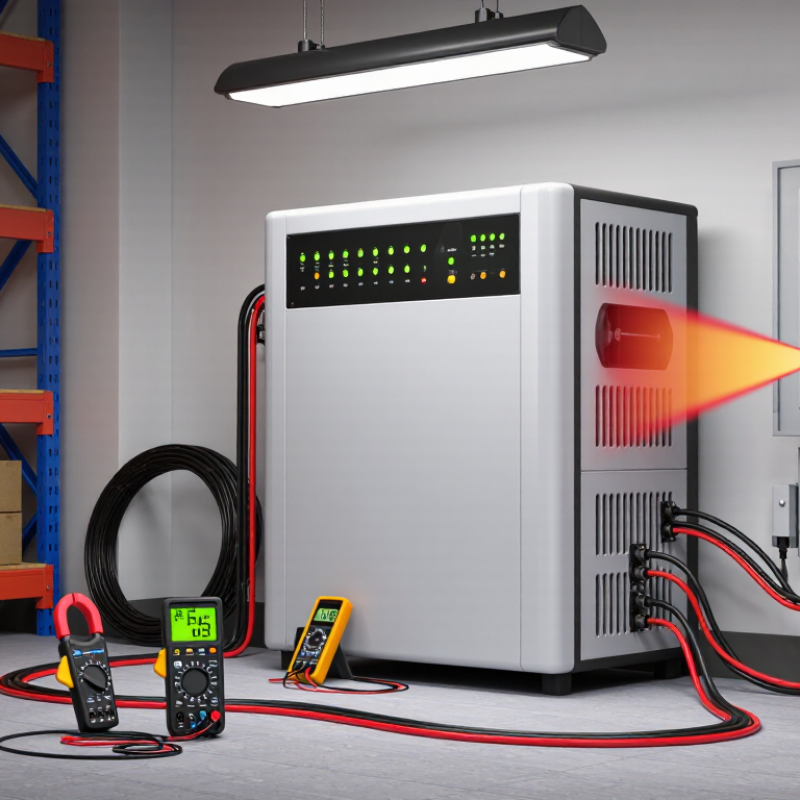
Use a calibrated multimeter to compare input and output voltage with the specifications. Loose terminals deserve attention. Look for heat marks, brittle insulation, or a burnt smell. Never open energized equipment. A qualified electrician should inspect internal wiring and protective devices.
Temperature also matters. Dust around ventilation openings, direct sunlight, and blocked airflow can trigger thermal protection. Move the unit to a dry, ventilated location and clean external vents regularly. Keep high-power appliances from starting together when possible. Installing suitable upstream protection may help, but it must match the electrical system and local requirements. Avoid bypassing a breaker or increasing its rating.
A useful maintenance log can reveal patterns. Record time, connected loads, weather, and voltage readings. I have seen “mysterious” trips disappear after one damaged cable was replaced. Still, load calculations can miss short startup surges. If tripping continues after loads are reduced, stop using the unit and arrange a professional test.
© 2007 - 2025 The Custom Packaging. All right reserved.